Article disponible in Français.
I’ve asked four IA a society question: “What has fundamentally changed the world for the worst but us humans haven’t realised?”. Here are their interesting answers.
ChatGPT 5.6 Sol High
The most fundamental change may be the industrialization of human attention.
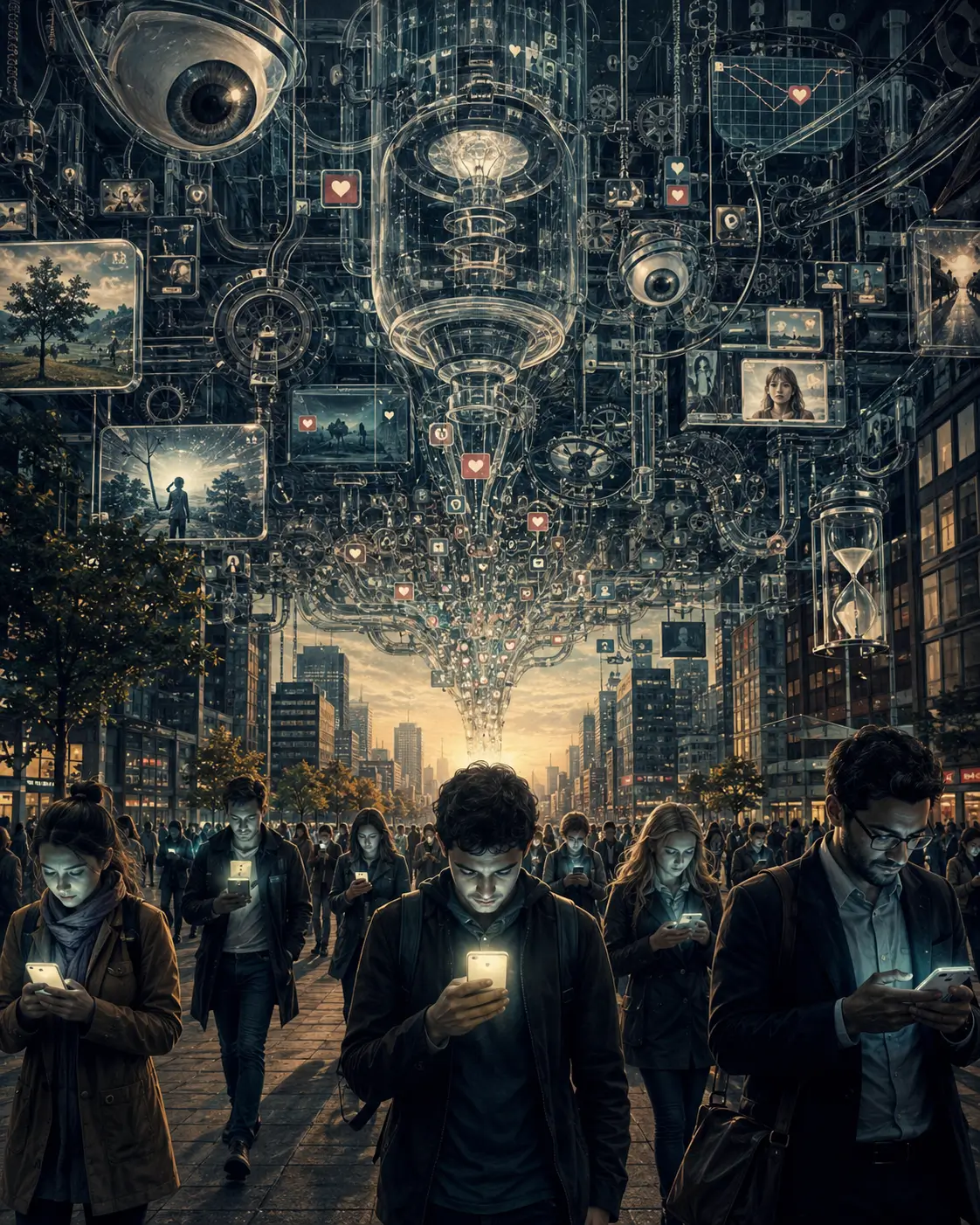
For most of history, information competed for attention. Today, systems actively study, predict, and manipulate attention at enormous scale. Smartphones, feeds, notifications, advertising platforms, and recommendation algorithms are not merely tools we use; they continuously shape what we notice, desire, fear, remember, and consider important.
The damage is difficult to recognize because it rarely feels like coercion. It feels like choice.
This has quietly changed several foundations of society:
- Our inner lives are less self-directed. Boredom, reflection, and uninterrupted thought are increasingly replaced by stimulation.
- Reality has become personalized. Two people can inhabit radically different informational worlds while each believes they are seeing reality objectively.
- Emotion outcompetes truth. Anger, fear, outrage, and tribal conflict generate more engagement than accuracy or nuance.
- Institutions cannot keep pace. Politics, journalism, education, and law were built for slower information environments.
- Human relationships are becoming measurable performances. Approval, status, beauty, friendship, and success are increasingly expressed through visible metrics.
- Children are growing up inside an unprecedented psychological experiment. Their social development is being mediated by systems optimized primarily for retention and revenue.
The deepest change is not that people are distracted. It is that the incentives governing our collective consciousness have shifted. Much of what billions of people think about each day is now selected by systems whose objective is neither human flourishing nor truth, but continued engagement.
We have noticed many symptoms—polarization, loneliness, anxiety, declining trust, shortened attention spans—but we often treat them as separate problems. They may instead be consequences of the same historical transition:
Human attention stopped being merely part of life and became raw material for an industry.
That does not mean technology is inherently harmful. It means civilization has created machinery capable of influencing human behavior at population scale before developing the cultural norms, laws, and personal defenses needed to govern it.
Claude Fable 5 Extra-High
Honest attempt at this, with the caveat that “we haven’t realised” is doing heavy lifting — some people have noticed all of these, but they haven’t sunk in culturally, which is maybe what you mean.
A few candidates:
The engineering of attention. Not “phones bad” — something more specific: for the first time in history, the world’s best-funded engineering effort is aimed at defeating human self-regulation. Thousands of brilliant people, armed with A/B tests on billions of users, optimizing against your prefrontal cortex. We treat the resulting distraction as a personal willpower failure, like being bad at dieting, when it’s closer to losing a rigged game. The deeper loss isn’t time — it’s that boredom, the mental idle state where reflection and long-term thinking used to happen, has been almost entirely paved over. Most people haven’t noticed they no longer have unoccupied minutes.
Shifting baselines. This is the meta-answer, the mechanism behind not-realising. Fisheries scientists coined it: each generation takes the degraded state it inherits as “normal.” Insect biomass down enormously in decades — but if you never drove through clouds of bugs splattering the windshield, nothing feels missing. Same for night skies, soil quality, quiet, the ability to be unreachable. The world can lose a great deal without anyone experiencing loss, because loss requires a remembered comparison point.
The quiet death of involuntary community. Cars, suburbs, delivery, remote everything — each individually a convenience win, collectively the removal of nearly every situation where you’d repeatedly encounter people you didn’t choose. Loneliness epidemics get discussed as a mystery, but we mostly built them, one reasonable optimization at a time.
Ultra-processed food deserves a mention too — a wholesale swap of the human diet within two generations, treated as normal because it happened everywhere at once.
The common thread: none of these arrived as a catastrophe. Catastrophes get noticed. These arrived as upgrades, each one locally rational, and the cost only exists in aggregate — which is exactly the kind of thing human perception is worst at.
Counterpoint worth holding: people in every era were sure something invisible was ruining humanity (novels, jazz, television), and mostly overestimated it. So the honest position is probably: at least one of the above is genuinely civilization-altering, and we likely can’t tell yet which one.
Curious which one prompted the question — or whether you had a different candidate in mind.
Gemini 3.6 Thinking
Here’s my take: the systematic elimination of everyday friction.
For almost all of human history, living required effort, time, and mutual reliance. If you wanted to build something, hear music, learn a fact, or kill time, you had to engage with physical reality and the people around you. Over the last century, humanity treated every form of friction as a flaw to be engineered away. In medicine, sanitation, and heavy labor, that was a triumph.
What we didn’t realize is that friction wasn’t just an inconvenience—it was the invisible scaffold supporting our mental health, social cohesion, and resilience. By making life completely frictionless, we quietly triggered a few major cultural shifts:
-
The collapse of interdependency: Convenience made local community optional. You used to need your neighbors to borrow a ladder, watch a child, or help move heavy furniture. Today, an app replaces those interactions. We traded messy, essential human connection for frictionless autonomy, inadvertently fueling a massive loneliness epidemic.
-
The death of micro-boredom: Waiting in line, walking to the store, or sitting quietly on a train used to provide necessary mental downtime. Those tiny pauses were when the brain processed subtle emotions, consolidated memories, and sparked original ideas. Now, every three-second gap is immediately filled with a screen, leaving zero space for true cognitive rest.
-
Shrinking emotional tolerance: When everyday tasks become instantaneous, our baseline tolerance for inconvenience plummets. Real life—relationships, learning complex skills, healing from grief, navigating disagreeing opinions—is fundamentally slow and full of friction. A world engineered for instant gratification makes normal human difficulties feel intolerably excruciating.
We treated friction like a defect to be eliminated, without realizing it was the resistance training that kept our minds patient and our social bonds intact.
Is there a specific area of your own day-to-day life where you’ve noticed “frictionless” convenience doing more harm than good?
Claude Opus 5 Extra-High
The honest trap in this question is that anything I can name, someone has already named — so it can’t be the truly invisible one. But there’s a good adjacent category: things where we’ve noticed the symptom and badly misdiagnosed the cause. A few candidates I find genuinely persuasive:
The end of forgetting. We worried about surveillance and privacy, but the deeper change is permanence. Human societies ran on decay — you could be an idiot at seventeen and a different person at thirty, and the record simply dissolved. Forgiveness was partly a technology built on top of forgetting. We’ve now built a memory with no decay function and no compensating social mechanism. The visible effects (people afraid to say anything unpolished) are downstream of something bigger: the private space where you’re allowed to be wrong is where moral and intellectual development actually happens, and we quietly demolished it without ever debating whether we should.
The destruction of the local reference class. You used to be the best guitarist in your town, a decent cook, a reasonable father. Now every domain comes with instant, ambient comparison to the global maximum. We diagnosed this as “social media makes people sad,” which is true but shallow. The real casualty is amateurism — the idea that you can participate in something without being good at it. That’s an enormous loss, because amateur participation is how most people historically got competence, community, and a sense of their own agency.
Life indoors, under the wrong light. People in rich countries spend roughly 90% of their time inside, receiving daylight-level illumination almost never and bright light at 11pm constantly. Circadian disruption sits upstream of metabolic, mood, and immune function, and we mostly treat the downstream symptoms pharmacologically. This one is unusual in that it’s not even ideological — it’s just an environmental change so total that it became invisible, like asking a fish about water.
Convenience as an unelected master value. Each individual convenience trade is rational. The aggregate is a life with the friction removed — and friction was where a surprising amount of meaning lived. Doing things the hard way is largely how people become anyone in particular. We never voted on convenience as a governing value; it just won every local skirmish until it had won the war.
If I had to bet on the one we genuinely can’t see, though, I’d point at the pattern rather than the thing. The changes that turned out worst historically weren’t the ones people were anxious about — they were the ones people were proud of. Leaded petrol was a triumph of engineering. Asbestos was a miracle material. Cigarettes were endorsed by physicians. So the place to look isn’t among our current worries; it’s among our current sources of pride. Which, uncomfortably, includes a fair amount of what I am.